Still Managing HR in Excel?
by Tilley Woodford on October 9, 2026
Still Managing HR in Excel?
Spreadsheets are often the starting point
Spreadsheets are often the starting point for HR administration. They are familiar, flexible and easy to set up. For a small team, they can feel like a perfectly sensible way to track employee information, leave, benefits, training or payroll inputs.
Why Excel becomes harder to manage as the business grows
The problem is that spreadsheets are rarely designed to become the long-term backbone of an HR function. As a business grows, HR information needs to be more accurate, more accessible and easier to report on. What once worked as a quick internal tracker can gradually become a point of risk.
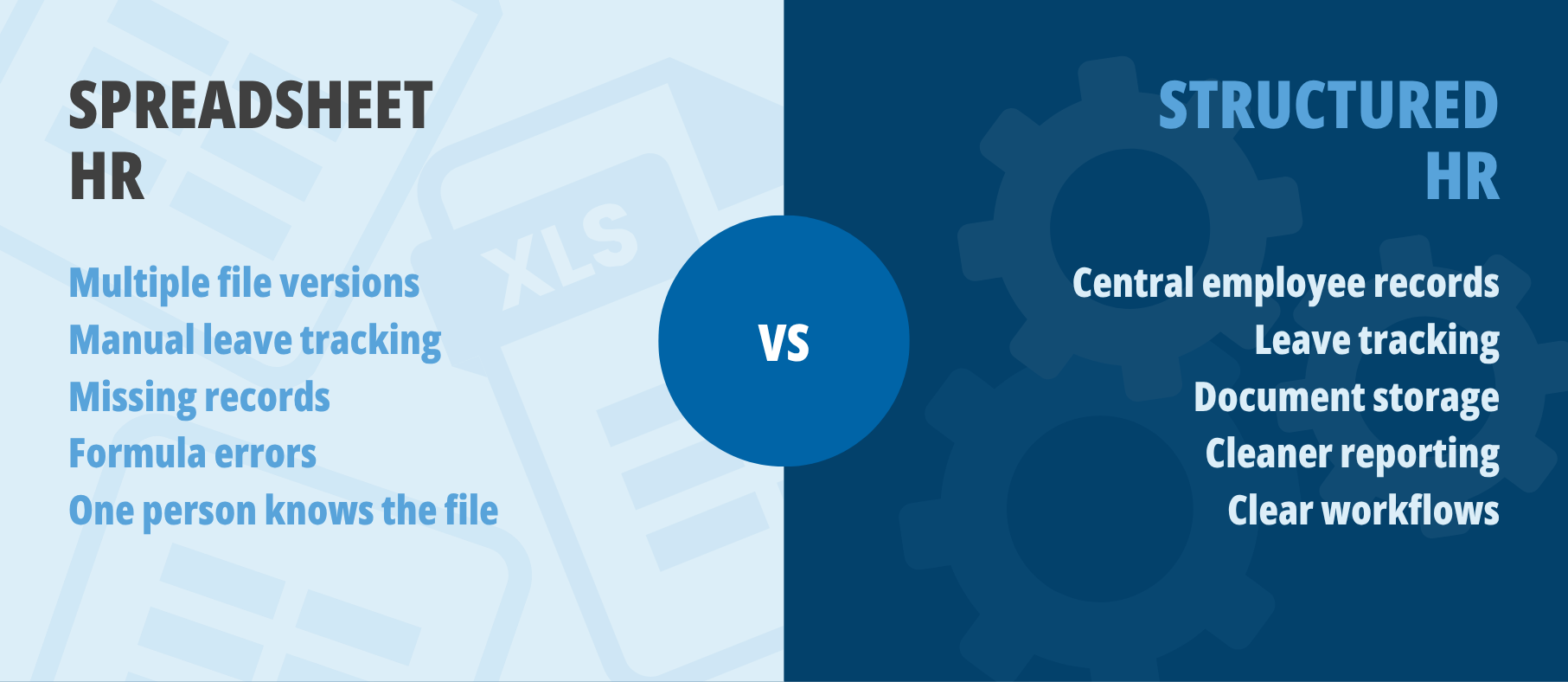
- Multiple versions of employee records
- Outdated or incomplete information
- Manual leave and benefits tracking
- Formula errors or accidental changes
- One person knowing which file is the “right” file
Why HR data matter
This creates more than an administrative inconvenience. HR records support important decisions. Managers rely on them for workforce planning, leave management, payroll inputs, employee relations, reporting and compliance. If the underlying information is inconsistent or hard to access, the business is more likely to make decisions based on incomplete data.
Manual HR administration also creates avoidable pressure on the people managing it. Time is spent updating files, checking information, reconciling differences and answering questions that a better system could help manage more efficiently. As the business grows, the process becomes harder to sustain.
What an HRIS can help solve
This is where a Human Resources Information System, or HRIS, can make a meaningful difference. An HRIS gives businesses a more structured way to manage employee information and related HR processes. Instead of relying on separate spreadsheets, saved files and email trails, employee data can sit in one clearer system with more consistent workflows.
Depending on the system and the business need, an HRIS can support areas such as employee records, document storage, leave and absence tracking, onboarding and offboarding workflows, payroll inputs, benefits information, reporting, management visibility, compliance and recordkeeping.
The real value is not just having software. It is having a better structure around the information and processes that HR depends on.
Moving to an HRIS does not need to be overwhelming
Moving to a more structured HR system does not need to be overwhelming. The first step is understanding what your business actually needs. Some companies need better employee records. Others need leave tracking, onboarding workflows, document storage, reporting or performance management tools. The right solution depends on the size of the team, the complexity of the processes and the level of internal support available.
An HRIS implementation should start with the process, not the platform. Before choosing or setting up a system, it is important to understand what is being managed now, where the current pain points are and what the business needs the system to do. Otherwise, there is a risk of simply moving messy processes from Excel into a new tool.
Excel may be where HR administration starts, but it should not be the only thing holding the function together.
Where HRIS implementation support can help
This is where HRIS implementation support can be valuable. CML can help businesses review their current HR administration, clarify requirements, identify practical system needs and support the move from spreadsheets or manual processes into a more structured HRIS. The aim is not to add unnecessary complexity. It is to create cleaner data, clearer workflows and better visibility.
Excel may still have a place in some areas, but it should not be the only thing holding your HR function together. If your team is spending too much time managing spreadsheets, struggling to trust the data or finding it difficult to produce basic HR reports, it may be time to consider whether an HRIS would give the business the structure it now needs.
Ready to move beyond spreadsheet-based HR?
CML supports HRIS implementation for businesses that want to move from manual HR administration to a more structured, reliable system. From reviewing current processes and clarifying requirements to supporting implementation and adoption, our team can help make the transition manageable and practical.
SHARE THIS ARTICLE
Recent Articles

Payroll mistakes cost more than money. Learn how payroll errors affect employee trust, management time and business reputation.

What happens during an HR audit? Learn what gets reviewed, why it matters and how an HR audit can help strengthen your business.

Payroll is more than paying employees. Explore the hidden HR, compliance, benefits and employee experience tasks that sit behind every payroll run.