
How Much Time Is Payroll Really Taking From Your Team?
by Tilley Woodford on November 2, 2026
How Much Time Is Payroll Really Taking From Your Team?
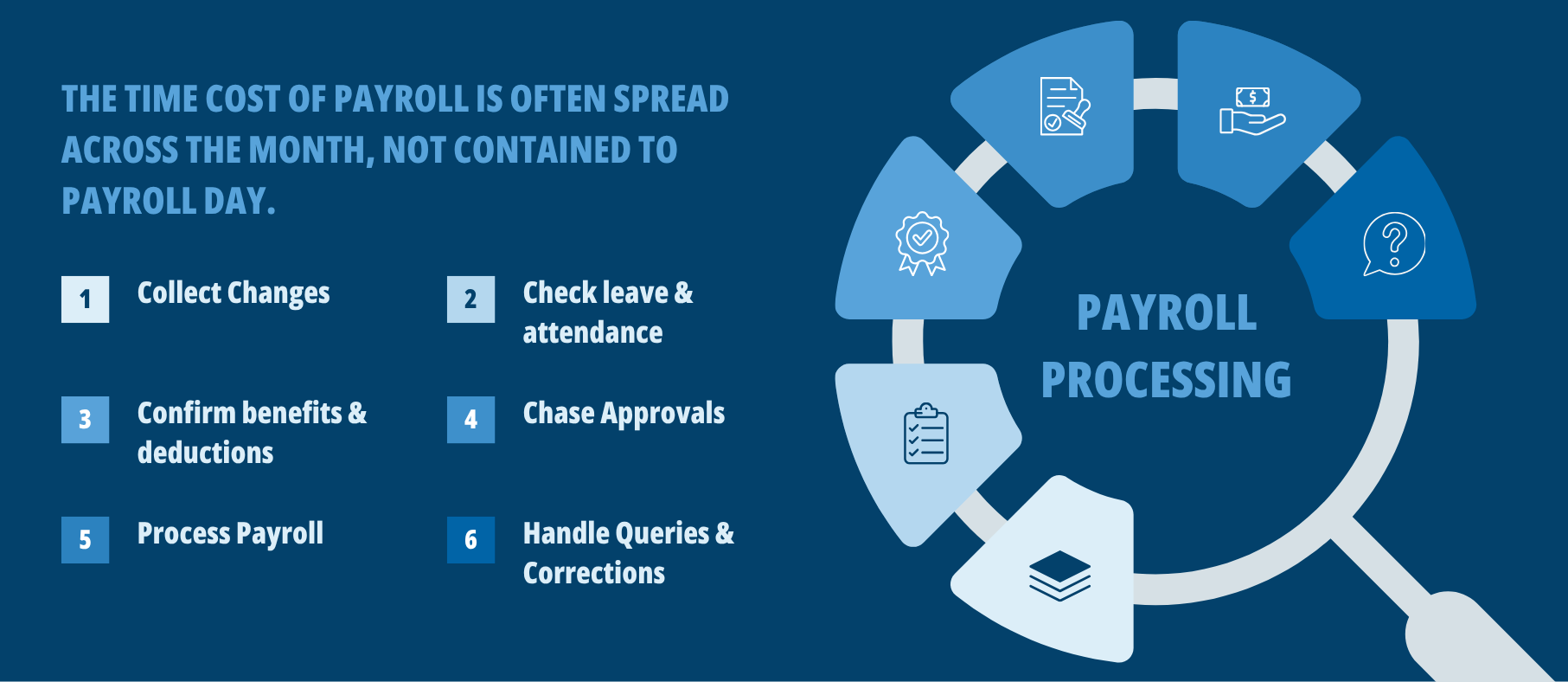
Payroll time is rarely limited to one task
When business owners estimate how long payroll takes, they often think only about processing day. The reality is that payroll is rarely a two-hour task once you account for collecting timesheets, chasing managers for approvals, checking leave balances, updating benefits, answering employee questions, correcting errors and producing reports. What looks like a few hours of administration can easily consume several days of attention across a month.
Because the work is spread across different people and different points in the month, it is easy to underestimate. No single task may feel significant on its own, but together they can pull time away from finance, HR, operations and management. For many businesses, the real question is not only “How long does payroll take?” but “How many people touch payroll every month?”
Where payroll time really goes
Many businesses underestimate payroll because the workload is spread across multiple people and multiple points in the month. A typical payroll cycle often includes collecting timesheets, overtime records and leave requests; chasing managers for missing approvals; updating salary changes, deductions and benefit adjustments; reviewing new starters and departures; processing payroll; investigating discrepancies or employee queries; and producing reports for management or finance.
- Collecting timesheets, overtime records and leave requests
- Chasing managers for missing approvals
- Updating salary changes, deductions and benefit adjustments
- Reviewing new starters, departures and employee changes
- Investigating discrepancies, employee queries and post-payroll corrections
The hidden cost of context switching
Payroll rarely takes up an entire day in one neat block. Instead, it interrupts dozens of other tasks. An HR administrator may stop what they are doing to answer a payroll question. A manager may need to approve leave. Finance may need to verify a deduction. Operations may need to confirm overtime hours. Individually, these interruptions seem minor. Collectively, they create a constant administrative drain across the organisation.
Time is not the only issue
Many businesses focus on the direct cost of payroll but overlook the productivity cost of repeatedly pulling people away from higher-value work. Payroll may technically sit with one person, but the process often relies on information, approvals and answers from several others. That makes payroll a capacity issue, not just an administrative task.
Where a payroll review can help
A payroll review can help identify where time is being lost, where unnecessary effort exists and where technology, process improvements or outsourced support could create capacity for more valuable work. The goal is not always to outsource the entire function. Sometimes the first step is simply understanding what is happening, who is involved and where the process is becoming heavier than it needs to be.
For many businesses, the real question is not “How long does payroll take?” but “How many people touch payroll every month?”
If payroll relies on spreadsheets, manual approvals, email chains and knowledge held by a small number of employees, the process may be consuming far more time than it appears on the surface. Looking at payroll through a capacity lens can help business owners make better decisions about whether to simplify the process, improve the workflow, introduce better tools or bring in external support.
Is payroll consuming more capacity than you realise?
CML can help businesses map their payroll processes, identify bottlenecks and reduce the administrative burden on internal teams. If you are unsure how much time payroll is really costing your business, our payroll specialists can help you assess the process and identify practical opportunities for improvement.
SHARE THIS ARTICLE
Recent Articles

Growing businesses need stronger HR foundations. Learn what usually breaks first when a company scales and how HR consulting can help.

Keeping payroll in-house may cost more than you think. Understand the hidden time, risk and dependency costs behind internal payroll management.

Human Resources Webinar - Targeted Recruitment Support Why we Hosted This AMA?